Travel by Any Means Necessary

Category: Travel Page 43 of 56

Acadia National Park: Park Loop Road

Thunder Hole at Acadia National Park

After we left Salem, we headed North to Maine. Upon first entering the state, I fell in love. There is something breathtaking and different about Coastal Maine. It looks like a mountain range, but smells like the beach. It was unlike anything I had ever experienced before. We arrived at Acadia and set up camp at Seawall Campground, which is located on the “quiet side” of the island. I didn’t really understand why they call it that until the next day.

Our first full day at Acadia was dedicated to driving the Park Loop Road. The Park Loop Road is the 27 mile road John D. Rockefeller Jr. built around Mount Desert Island so visitors can explore the park by automobile (instead of driving cars on the miles of the park’s carriage roads). We began our tour at the Hulls Cove Visitor Center. While at the visitor center, we picked up an audio tour of the park look road to listen to on our drive. I really enjoyed it because we learned some history of the park as well as some information about natural side of Acadia. Also at the visitor center, we got our first taste of Acadia’s summer crowds. Holy Cow. Before this trip, I read Moon’s Acadia National Park Travel Guide and it mentioned that July and August are the busiest times to visit Acadia. I went into it picturing the Sleeping Bear Dunes on Labor Day but it was more like Disney World around Christmas. Parking lots were packed. As you can see in the Thunder Hole picture above, people were just everywhere. Truly, trying to get a clear picture was like trying to get a picture of Cinderella’s Castle without the people in it. It just wasn’t going to happen. Between the crowds and the heat, I really struggled with photographic inspiration in one of the most beautiful places I have ever seen.

Schooner Head Overlook at Acadia National Park

The Moon book really pushed for visitors to use the free Island Explorer Buses (sponsored by L.L. Bean). They reduce emissions and help with the crowded parking lots. We decided for our first day in the park we would drive the Park Loop Road to give us the flexibility to stop and see anything we wanted to see. One of our first stops was the Schooner Head Overlook (left). Compared to the rest of the park and other sections of the Park Loop road, this was a very quiet spot. We only saw a few people on the trail, one of which was setting up an easel to paint. This would be a great place to watch a beautiful Acadia sunrise and to catch the first rays of sun in the United States.

Of course, we had to stop at Thunder Hole (above). It was very cool to hear the waves thundering into the natural rock inlet. It really does sound like thunder. We wanted to stop at Sand Beach and see the only sandy beach in the park, but we couldn’t find a parking spot, so we kept driving. If you are looking to visit Sand Beach, I highly recommend taking the Island Explorer because we visited around 9 the next morning and the parking lot was already full.

Crowds aside, I do recommend driving the Park Loop Road at least once because the Island Explorer bus doesn’t stop at every place you may want to see. In particular, the bus does not go to the top of Cadillac Mountain, so if you want to see the highest peak on the east coast (and if you’re in Acadia, you should) you can only get there by car or by climbing it. Personally, I don’t hike something if I can drive it and I definitely don’t hike up the side of a mountain, so we drove and that is the topic for next week! Be sure to come back to hear all about it!

If you like my photos be sure to “like” my Facebook Page, follow me on Instagram, and Flickr! You can purchase prints on Etsy and Fine Art America. To see inside my camera bag, check out my Gear Page. For information about our new Guided Photography Tours, visit GuidedPhoto.com.

The House of Seven Gables

Salon in the Turner-Ingersoll Mansion with hand painted wallpaper

The Turner-Ingersoll Mansion, also known as The House of Seven Gables, is located in Salem, Massachusetts. It was built in 1668 by Captain John Turner and is the oldest timber frame house on its original foundation in the United States.  What is the significance of this old, New England home? It was the setting of Nathaniel Hawthorne’s 1851 novel, The House of Seven Gables.

Unlike The Wayside, Hawthorne never lived in this home, but he often visited his cousin, Susanna Ingersoll who regaled him with stories of the home. At the time that Hawthorne visited, four of the gables had been removed to match current architectural trends, but Ingersoll showed her cousin the beams and mortises in the attic illustrating where the additional gables used to be. If you’ve ever read the story, you know that the house is practically described as an additional living character.

A rare photo of me outside the Counting House at the House of Seven Gables.

In the early 1900s, the home was purchased by Caroline O. Emmerton who worked with an architect  to make the house reflect the one in Hawthorne’s story. Restorations included adding back the missing gables, creating a secret passageway in a chimney and adding a cent shop like the one run by Hepzibah Pyncheon in The House of Seven Gables.

Other historic Salem buildings have been moved to the grounds at the House of Seven Gables and can be toured with museum admission. Most noteably of these is Nathaniel Hawthorne’s birthplace.

If you are in Salem, I definitely recommend a stop at The House of Seven Gables. Unfortunately, due to the oppressive heat (it was 90 degrees at 10 AM), we didn’t get to see much more in Salem. After we left the museum, we headed north towards Acadia. Check back next week for our first look at Acadia National Park!

Thanks for stopping by! For more information about the House of Seven Gables visit 7gables.org. If you like my photos be sure to “like” my Facebook Page, follow me on Instagram, and Flickr! You can purchase prints on Etsy and Fine Art America. To see inside my camera bag, check out my Gear Page. For information about our new Guided Photography Tours, visit GuidedPhoto.com.

Boston Freedom Trail

Faneuil Hall – Boston

When planning our day in Boston, the one thing I knew I wanted to see was the Freedom Trail. Boston’s Freedom Trail is a two and a half mile route throughout the city marked with a red line that leads to 16 sites from the American Revolution. The trail begins at Faneuil Hall where we caught a free walking tour led by the National Park Service. Throughout the years, Faneuil Hall has had many purposes. The lower level is a marketplace. The second floor served as Boston’s Town  Meeting Hall (above) and the third floor held the town’s armory (NPS).

U.S.S. Constitution AKA Old Ironsides

Boston Common (bottom right), Old North Church, Old South Meeting House, Paul Revere’s House, the Site of the Boston Massacre, and the U.S.S. Constitute (left) are just a few of the sites along the Freedom Trail. The trail ends at the Bunker Hill Monument which commemorates one of the first battles of the American Revolution. Unfortunately it was closed during our visit due to extreme heat.

Soldiers & Sailors Monument in Boston Common

We were able to tour the U.S.S. Constitution. The U.S.S. Constitution is the oldest commissioned naval vessel still afloat and was named by George Washington. Interestingly, “Old Ironsides” is made entirely of wood. She was given the name during the War of 1812  when British cannonballs seemed to bounce right off of her. The ship’s copper fastenings were made by Paul Revere (Freedom Trail).

If you are planning on visiting Boston, I highly recommend the National Park Service Tours. For one it doesn’t cost anything and the tour guides are highly knowledgeable. Our guide wrote her Doctoral Dissertation on Paul Revere. I’m sure those other tours don’t have guides with that kind of expertise!

There is so much to see and do and Boston and one day is really not enough time to explore it all. Boston is definitely on my list of places to return with more time!

Thanks for stopping by! If you like my photos be sure to “like” my Facebook Page, follow me on Instagram, and Flickr! You can purchase prints on Etsy and Fine Art America. To see inside my camera bag, check out my Gear Page. For information about our new Guided Photography Tours, visit GuidedPhoto.com.

Pin This:


Wordless Wednesday: Old South Meeting House

Museum of Fine Arts Boston

Wall of Monet paintings at the Museum of Fine Arts, Boston

Before our trip, we weren’t planning on stopping at the Museum of Fine Arts in Boston, but then we heard that they had the largest collection of Monets outside of Europe and we had to check it out. Gallery 252 is dedicated exclusively to works of Monet. Grand Canal, Venice hangs on the wall in there as well as Meadow with Poplars. They also have a large collection of American Impressionists and the most complete collection of John Singer Sargent anywhere. If you enjoy impressionist paintings, this museum is a must see!

Of course, the MFA is a large, urban art museum and has more to offer than just impressionists. They have a large wing full of modern art and as well as ancient art. One of my favorite galleries in the museum is the musical instrument collection. They had crazy instruments I had never seen before! Of course, this bass clarinet player had to take a picture of the small, curvy bass clarinet on display! They also have galleries dedicated to jewelry and textiles. If you enjoy art, there is something for you to see at the Museum of Fine Art, Boston.

If you plan to visit the MFA, plan to get their early or you will have to wait in line outside. It was 90 degrees and sunny on our Boston day and they didn’t have an awning or anything to stand under. It got pretty hot and uncomfortable waiting to get inside. We visited through the ROAM (reciprocal admissions) program with our DIA membership and the girl behind the counter was happy to tell that the DIA is one of her favorite museums. That made me smile.

To plan a trip to the Museum of Fine Arts, Boston, visit MFA.org. If you like my photos be sure to “like” my Facebook Page, follow me on Instagram, and Flickr! You can purchase prints on Etsy and Fine Art America. To see inside my camera bag, check out my Gear Page. For information about our new Guided Photography Tours, visit GuidedPhoto.com.

Pin This:

Minute Man National Historic Park

Minute Man National Historic Park, located just outside of Boston, is home to many sites of significance of the first battle in the battle for American Independence. There are many sites of important historical significance located inside the park. The Battle Road Trail is a 5 mile trail that connects many of the sites within the park and would be a fun way to explore the park. Since this was our third stop of the day, we didn’t have much time to explore the park before it closed, so we drove between sites to maximize time.

The Old North Bridge, one of the sites in the park, is where the “shot hear round the world” was fired. The Minute Man statue (left) is located near the bridge and interestingly is made from seven cannons that were used in the American Civil War (wiki).  A monument at the site of Paul Revere’s Capture can be seen along the Battle Road Trail. Hartwell Tavern is another stop on the trail where costumed re-enactors talk about the home turned tavern and life in Massachusetts in the late 18th century.

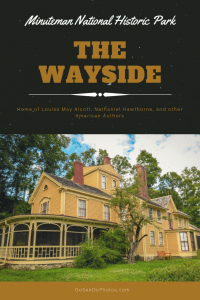
Pictured above is the Wayside, which is a home that has housed many famous American authors. Louisa May Alcott lived in the home as a child and it is said that her time at the Wayside inspired many scenes from Little Women. The Alcotts sold the home to Nathaniel Hawthorne (author of the Scarlet Letter and The House of Seven Gables among others) who named it The Wayside because it was so close to the road, he worried it would be mistaken for a coach stop. After Hawthorne’s death, the home was purchased by his son-in-law and author, George Parsons Lanthrop. Four years after that, Boston publisher Daniel Lothrop purchased the home with his wife, Harriet who wrote children’s books under the pen name, Margaret Sidney. In 1963 the home was named a National Landmark and joined Minute Man National park two years later (wiki).

The park is full of history and I recommend you take a trip to visit if you are in the Boston area. For more information, visit the National Park Service. If you like my photos be sure to “like” my Facebook Page, follow me on Instagram, and Flickr! You can purchase prints on Etsy and Fine Art America. To see inside my camera bag, check out my Gear Page. For information about our new Guided Photography Tours, visit GuidedPhoto.com.

Pin This:

Wordless Wednesday: Seawall

Eric Carle Museum of Picture Book Art

A rare photo of me at the Eric Carle Museum

Ever since I discovered that there was a museum dedicated to picture book art, specifically Eric Carle art, I knew this was a place I would have to visit. So, when mapping out our East Coast Road Trip, I was excited to discover it was only about an hour out of the way.

The museum in Amherst, Massachusetts was founded by legendary children’s book illustrator, Eric Carle. The museum is definitely geared towards children and families with interactive exhibits at the children’s level. The museum is home to three galleries: the Eric Carle gallery and two rotating galleries. My favorite was definitely the Eric Carle gallery. It was interesting getting to see unpublished pages from his books as well as a timeline of his life. During our visit, the middle gallery featured the art of Leo and Diane Dillon. I don’t know that I had ever read any of their books, but the art featured was beautiful. The east gallery featured a Paddington bear exhibit that the kids really seemed into. I’ve never read any Paddington books or seen any of the movies, so I couldn’t really relate to it.

Admission to the Eric Carle Museum is only $9 for adults; youth, teachers, and seniors are $6. It is a small museum but it is definitely worth a visit if you have children or are just a fan of picture books like me! Admission includes the galleries, the picture book library (that is organized by illustrator, not author, in case you were wondering), and the art studio where kids can create their own art. The museum is also home to an auditorium that features films inspired by children’s books as well as live music, theater performances, and lectures. Most are included with museum admission. Beginning on September 8, the Eric Carle exhibit is transforming in celebration of the 50th anniversary of The Very Hungry Caterpillar! I wish I could go back to check it out!

Thanks for stopping by! To plan your visit to The Eric Carle Museum, visit carlemuseum.org. If you like my photos be sure to “like” my Facebook Page, follow me on Instagram, and Flickr! You can purchase prints on Etsy and Fine Art America. To see inside my camera bag, check out my Gear Page. For information about our new Guided Photography Tours, visit GuidedPhoto.com.

Wordless Wednesday: Sweet Waters of Acadia

Onieda Community Museum

The first stop on our recent East Coast Road Trip was at the Onieda Community Mansion Museum. This is an interesting place with a unique history. We had first heard about the Onieda Mansion on an episode of Planet Money. You know the Onieda silverware company, right? Did you know that they started out as a 19the century, perfectionist cult and free love commune? The mansion house (now a museum) was the home of the Onieda Community from 1848-1880. Led by John Humprey Noyes, the community “challenged social views on property ownership, gender roles, child-rearing practices, monogamous marriage, and work.” The community was way ahead of its time in the in the rights of women, in that the women of the community were able to participate in community work and they played an active role in shaping policy of the commune. (wiki and Onieda Community)

The mansion house itself is a beautiful building with unique details. There are many community spaces to explore including a beautiful library. There is also a large meeting space where the 300 members of the community would come together for religious purposes as well as community meetings. It is hard to imagine 300 people living together under one roof. Nowadays, the building houses a museum, gift shop, as well as apartments, and guest rooms. It was a very interesting place, but I will admit it had a kind of creepy vibe to it. The Onieda Community may have failed as a cult/commune/eugenics experiment, but they do make nice silverware.

While in Onieda, we also discovered the Wold’s Smallest Church. The Cross Island Church was built for a wedding so it can house a couple with a minister while the guests watch from boats on the water. I wish we had heard about this place earlier because we may have called ahead for a tour, instead we viewed it from the road. More information about this tiny church can be found at RoadSideAmerica.com.

Thanks for stopping by and reading what has to be one of the strangest posts on this blog! If you like my photos be sure to “like” my Facebook Page, follow me on Instagram, and Flickr! You can purchase prints on Etsy and Fine Art America. To see inside my camera bag, check out my Gear Page. For information about our new Guided Photography Tours, visit GuidedPhoto.com.

Pin This:


Page 43 of 56

Powered by WordPress & Theme by Anders Norén